

Part 6 | Why the Future of Water Hygiene Does Not Necessarily Have to Be Chemical
Why modern water hygiene is increasingly focusing on prevention and physical processes.
For many decades, microbiological challenges in drinking water hygiene have primarily been addressed using chemical disinfection processes. Chlorine, chlorine dioxide, ozone and other disinfectants have proven effective in numerous applications and remain important components of water treatment today.
At the same time, however, the requirements placed on modern drinking water installations are changing. Energy efficiency, sustainability, material compatibility and the most resource-efficient operation possible are becoming increasingly important. This raises the question of whether chemical processes must continue to be the only or best solution in every situation in the future.
Water hygiene does not begin with disinfection
Findings from recent years show that hygiene-related problems are rarely caused by a single factor.
Biofilms develop over extended periods of time. Stagnation changes the microbiological conditions within a drinking water installation. Unfavourable temperatures and hydraulic weaknesses can further promote the growth of microorganisms.
Reducing these causes on a long-term basis also creates less favourable conditions for undesirable microorganisms. As a result, the focus is increasingly shifting away from exclusively controlling existing microorganisms towards preventing the conditions under which they can multiply.
Prevention is becoming increasingly important
This approach is also reflected in modern water safety plans.
Instead of responding only once microbiological limit values have been exceeded, potential risks should be identified and assessed as early as possible and reduced through appropriate measures.
Prevention does not mean avoiding disinfection altogether. Rather, the aim is to prevent hygiene-related risks from developing in the first place wherever possible. Appropriate hydraulic design, the avoidance of stagnation, stable temperature management and regular water replacement all play an important role. Continuous monitoring of critical operating parameters and the permanently hygienic operation of the entire installation are equally important.
Alternative processes expand the possibilities
Alongside this changing understanding, the available technologies are also continuing to develop.
In addition to chemical and thermal processes, physical processes are increasingly available today and, depending on the application, can provide a useful complement or alternative. These include, for example, UV irradiation, membrane processes and hydrophysical technologies.
These processes follow different technical approaches but share a common objective. They are intended to help ensure the hygienic quality of drinking water over the long term.
Which technology is suitable always depends on the specific application as well as the technical, hygienic and economic requirements. There is therefore no universally applicable solution for every drinking water installation.
Sustainability is becoming an important decision-making factor
Alongside hygienic effectiveness, other criteria are becoming increasingly important. These include energy consumption, operating costs, maintenance requirements, the impact on the materials used and the responsible use of resources.
These factors are playing an increasingly important role when selecting a suitable process. Regulatory and societal developments are also reinforcing the expectation that the use of chemicals should be reduced wherever suitable alternatives are available and a comparable level of protection can be achieved.
This is creating new momentum for innovative technologies and operating concepts within water treatment.
The future will be more diverse
Water technology is undergoing a transformation.
Whereas in the past the focus was often on finding one correct solution, there is now growing recognition that different applications require different concepts.
Hospitals have different water hygiene requirements than hotels. Industrial facilities differ significantly from residential buildings. Mobile water treatment also operates under different conditions than a stationary drinking water installation.
The future of water hygiene is therefore unlikely to be shaped by a single technology. Instead, intelligent and coordinated solutions tailored to the actual requirements of each individual installation will become increasingly important.
Conclusion
Chemical disinfection processes will continue to have an established place in water technology in the future. At the same time, there is a growing expectation that their use should be carefully assessed and reduced where suitable alternative processes are available.
Physical technologies, preventive operating concepts and modern water safety plans are expanding the possibilities for sustainable drinking water hygiene.
The key question in the future will therefore no longer simply be:
“Which disinfectant should we use?”
Far more important will be the question:
“How can we create permanently hygienic conditions throughout the entire drinking water installation?”
Sustainable water hygiene does not begin with the choice of a single technology. It begins with a holistic understanding of the entire drinking water installation and the conditions under which it is operated.
VISION AQUA® Umkehrosmoseanlagen und Wasserfilter
Average rating of 5 out of 5 stars
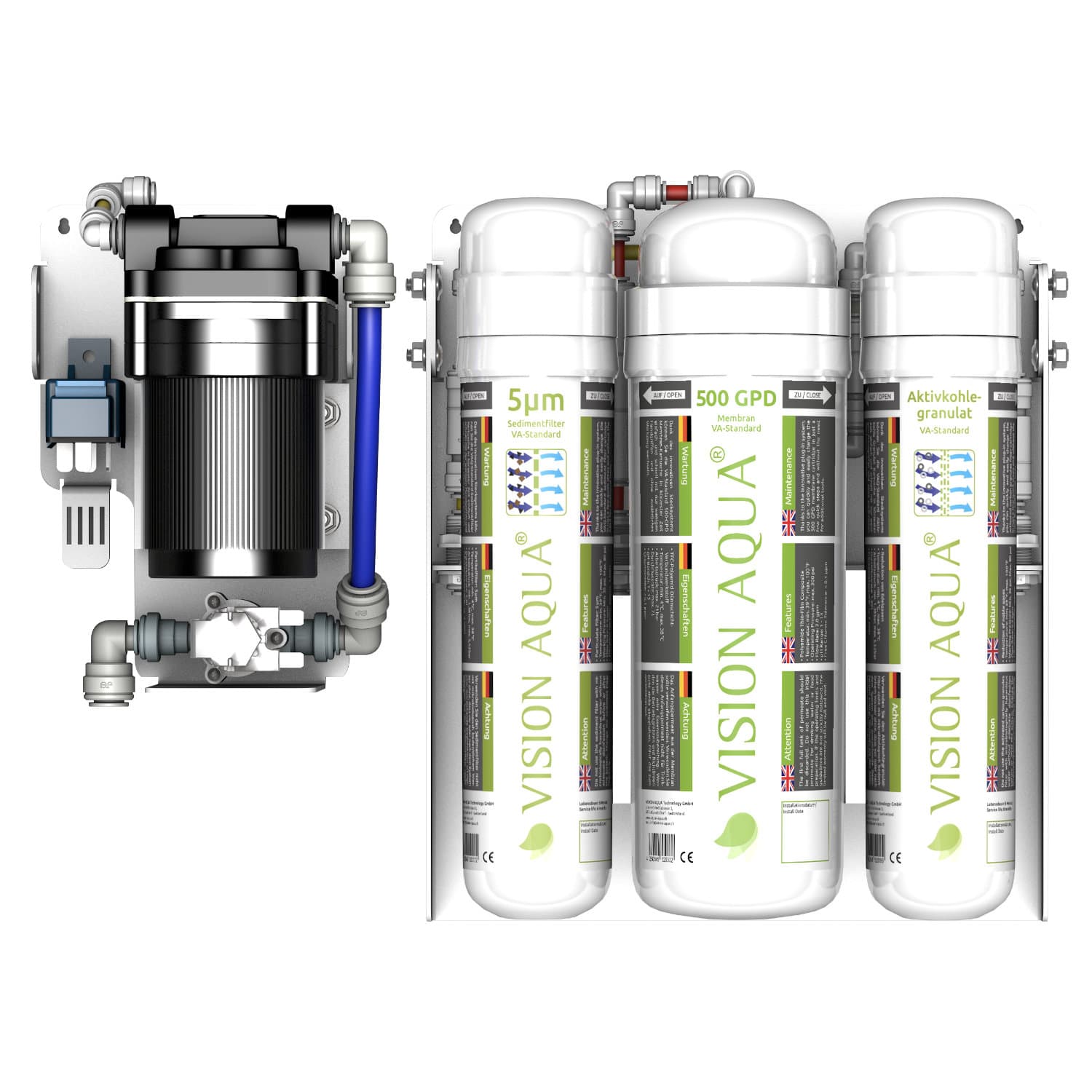
Scope of delivery:1 x VA Basic PLUS1 x VA-Standard - 500 GPD Membrane - Filmtec Material1 x VA-Standard - Sediment-Filter, PP cartridge (pre-filter)1 x VA Standard - Granulated Activated Carbon Filter, GAC Cartridge (post-filter)1 x Booster Pump 800 GPD - DirectDrive Brushles 24V - 2 x 3/8" tube outer diameter1 x Pressure switch - 1-10 Bar - 1/4" external thread - stainless-steel (incl. clamp for assembly)1 x installation set1 x 1-way tap, tap with straight connector - 1/4" tube external diameter (set)Hints!The system is delivered dry and has not been flushed!The system must first have produced 10-15 liters of water before it can be used for drinking water production.
Average rating of 5 out of 5 stars
Scope of delivery:1 x VA Basic PLUS1 x VA-Standard - 500 GPD Membrane - Filmtec Material1 x VA-Standard - Sediment-Filter, PP cartridge (pre-filter)1 x VA Standard - Granulated Activated Carbon Filter, GAC Cartridge (post-filter)1 x Booster Pump 800 GPD - DirectDrive Brushles 24V - 2 x 3/8" tube outer diameter1 x Pressure switch - 1-10 Bar - 1/4" external thread - stainless-steel (incl. clamp for assembly)1 x DC converter SD-100A-24 - 24V / 4.2A - Mean Well1 x installation set1 x 1-way tap, tap with straight connector - 1/4" tube external diameter (set)Hints!The system is delivered dry and has not been flushed!The system must first have produced 10-15 liters of water before it can be used for drinking water production.

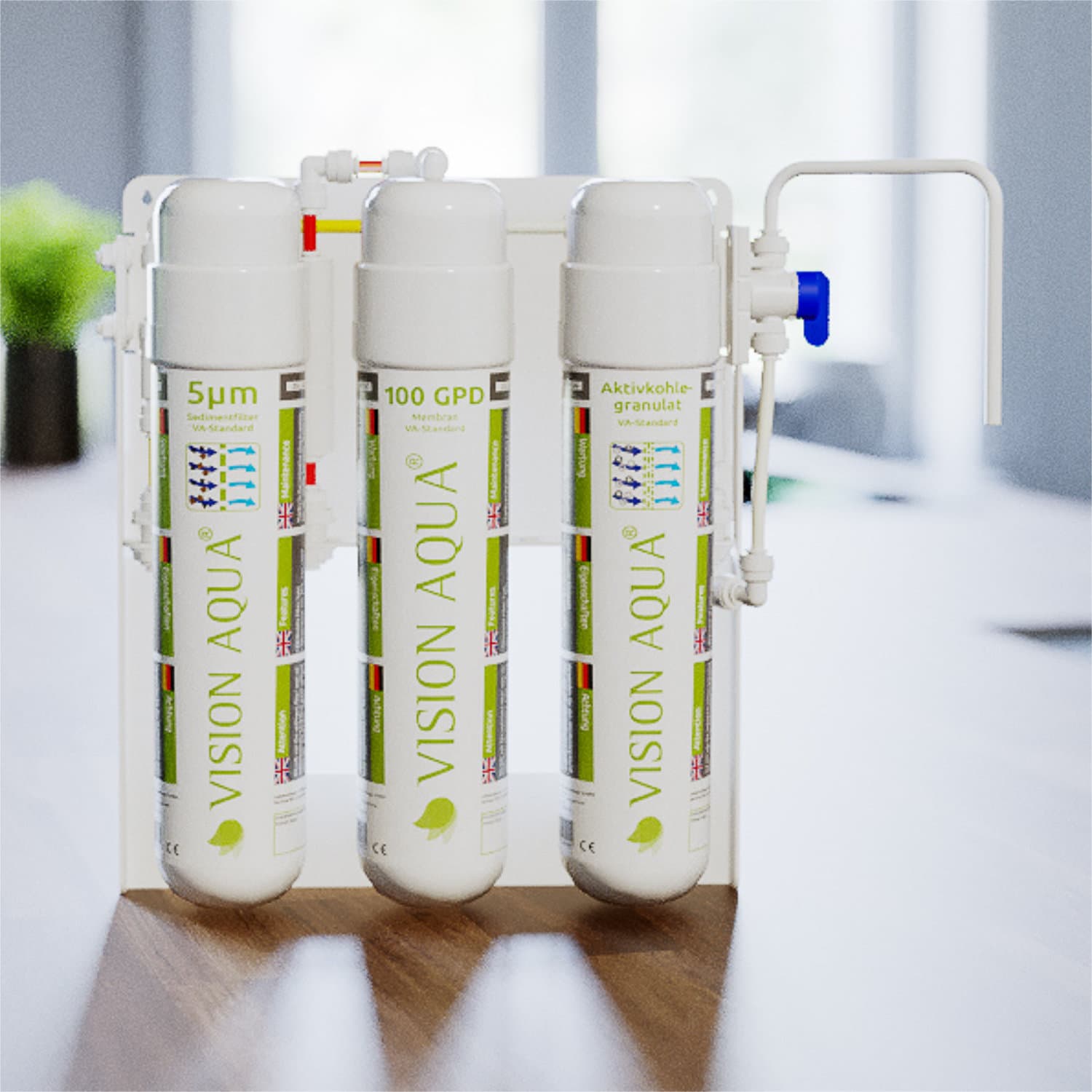
Scope of delivery:1 x VA Basic1 x VA-Standard - 100 GPD Membrane - Filmtec Material1 x VA-Standard - Sediment-Filter, PP cartridge1 x VA Standard - Granulated Activated Carbon Filter, GAC Cartridge1 x Plastic tube for inlet - 1/4", 6.35 mm - color: yellow - John Guest, length: 2 m1 x Plastic tube for waste water - 1/4", 6.35 mm - color: red - John Guest, length: 2 m1 x Tap connector adapter with aerator and return for wastewater - M22 inner thread to 1/41 x M24 AG to M22 AG long version - water filter faucet adapter1 x M24 AG to M22 AG - water filter faucet adapter1 x 1/4" tap with stainless steel folding spout3 x filter cap - suitable for VA standard filter cartridgeHints!The system is delivered dry and has not been flushed!The system must first have produced 10-15 liters of water before it can be used for drinking water production.
Weitere Blogbeiträge zum Thema Trinkwasser
Abkochverfügung für 20.000 Menschen im Landkreis Rosenheim
Wasserabkochmeldungen

Gefährliche Bakterien im Leitungswasser der Uniklinik Essen nachgewiesen
Wasserabkochmeldungen

In Bad König gilt ein Abkochgebot für das Trinkwasser
Wasserabkochmeldungen
Bleiben Sie auf dem Laufenden!

